
“Quills” (2000), directed by Philip Kaufman, is a historical drama that revolves around the life of the infamous French writer, the Marquis de Sade. Known for his provocative and controversial works that explored themes of sexual freedom, power, and taboo, the Marquis de Sade remains one of history’s most notorious figures. Quills takes a fictionalized look at his life, particularly focusing on his time in an insane asylum, where he continues to write his erotic novels despite the oppressive and restrictive environment. The film blends elements of history, romance, and social critique, making it an intriguing exploration of the intersection between creativity and the human psyche.
In this review, we will delve into the key themes, performances, direction, and overall impact of Quills, while exploring why it remains a captivating and thought-provoking film more than two decades after its release.
The Plot of Quills
The plot of Quills is set in the late 18th century, focusing on the life of the Marquis de Sade (played by Geoffrey Rush). At the time of the film, he is imprisoned in the Charenton Asylum for his controversial writings, which often dealt with explicit and taboo subjects. Despite being locked away in a mental institution, the Marquis is far from silenced. He continues to write prolifically, using his words as a form of defiance against the authorities that seek to control him.
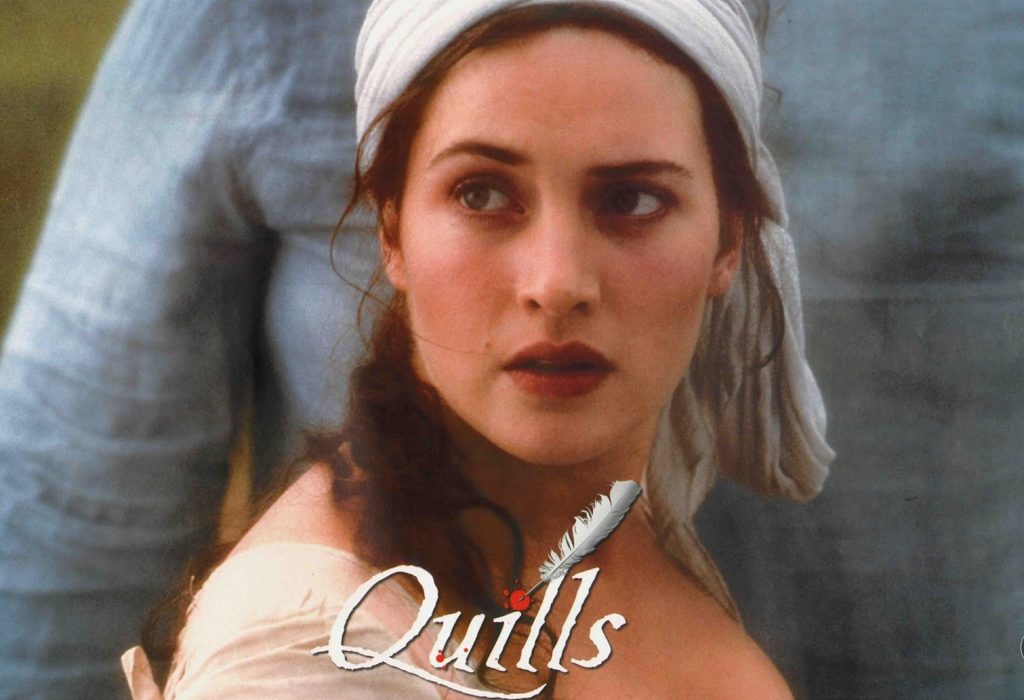
The narrative of Quills revolves around the Marquis’s relationship with Madeleine LeClerc (Kate Winslet), a laundress at the asylum. Madeleine is drawn to the Marquis’s writings, and the two form a passionate and tumultuous relationship. As their bond deepens, the film delves into the themes of desire, repression, and the tension between societal norms and individual expression.
The story takes a dramatic turn when the Marquis’s writings are smuggled out of the asylum and published, leading to a series of events that force him to confront his personal demons and the consequences of his art. The film explores the fine line between genius and madness, questioning whether the Marquis’s provocative works are a form of artistic expression or a manifestation of his own psychological instability.
Themes in Quills – Art, Desire, and Repression
One of the central themes of Quills is the conflict between art and repression. The Marquis de Sade’s works, which pushed the boundaries of sexual and social taboos, were often regarded as obscene and immoral. However, Quills presents a compelling argument that the Marquis’s writing was not merely a reflection of depravity, but rather an act of resistance against a society that sought to suppress individual freedom and expression.
In the film, the Marquis uses his writing as a tool to express his innermost desires and frustrations. He is confined within the walls of the asylum, yet his words allow him to transcend his physical limitations and challenge the social order. The idea of the written word as a powerful form of liberation is central to Quills, as the Marquis’s works offer a form of escape from the rigid constraints of society, even as they lead to his eventual downfall.
Another significant theme in Quills is the tension between desire and repression. Madeleine, a young and curious laundress, becomes enamored with the Marquis’s writings and soon becomes his lover. Their relationship is both passionate and dangerous, as it forces Madeleine to confront her own desires in a world that seeks to suppress them. The film explores how society’s strict moral codes shape our understanding of love, desire, and the boundaries of acceptable behavior.
The film also touches upon the hypocrisy of societal norms. While the ruling class and clergy publicly condemn the Marquis’s works, they secretly indulge in similar vices. This double standard is portrayed as a form of moral repression, where those in power seek to control and suppress the desires of others, while simultaneously engaging in their own forms of indulgence.

Performances in Quills – A Stellar Cast Brings the Story to Life
The performances in Quills are a key element that elevates the film to its status as a memorable and impactful drama. Geoffrey Rush’s portrayal of the Marquis de Sade is nothing short of captivating. Rush brings complexity and depth to the character, capturing the Marquis’s intelligence, defiance, and dark sense of humor. He is both a tragic figure and a symbol of resistance, and Rush’s performance conveys this duality with nuance and skill.
Kate Winslet’s portrayal of Madeleine is equally compelling. Winslet brings a sense of innocence and curiosity to her character, which contrasts sharply with the Marquis’s more jaded and cynical outlook. As Madeleine becomes more entangled in the world of the Marquis, Winslet’s performance beautifully captures the internal conflict between desire and societal expectations. Her chemistry with Rush is palpable, making their relationship both tender and dangerous.
Other notable performances in Quills include Joaquin Phoenix as Dr. Royer-Collard, the asylum’s physician who is tasked with overseeing the Marquis’s treatment. Phoenix brings a quiet intensity to his role, portraying a man torn between his professional duties and his personal attraction to Madeleine. Phoenix’s performance serves as a foil to the Marquis’s free-spirited and rebellious nature, highlighting the film’s exploration of the clash between reason and passion.

Direction and Cinematography
Philip Kaufman’s direction in Quills is a masterclass in balancing historical drama with contemporary sensibilities. Kaufman expertly blends the historical backdrop of the Marquis de Sade with the film’s more modern themes of rebellion, desire, and the fight for artistic freedom. The pacing of the film is deliberate, allowing the complex relationships between the characters to unfold gradually, while still maintaining an engaging sense of suspense and drama.
The cinematography by John Toll is equally impressive. The film’s visual style captures the contrast between the confined, oppressive environment of the asylum and the lush, sensual world of the Marquis’s imagination. The use of light and shadow is particularly effective, with the dark, gothic interiors of the asylum juxtaposed against the more vibrant and passionate moments between the characters.
The film’s set design and costume work also play a crucial role in establishing the tone and atmosphere. The lavish period costumes and intricate sets bring the 18th-century world to life, while also reflecting the psychological and emotional states of the characters. The visual aesthetic of Quills enhances the story’s themes of repression and desire, creating a world where art, passion, and madness collide.
The Legacy of Quills
Since its release, Quills has garnered a cult following for its daring approach to the story of the Marquis de Sade. The film stands out for its bold exploration of themes such as artistic freedom, sexual liberation, and the consequences of living outside societal norms. While some critics have questioned the film’s historical accuracy, it is important to remember that Quills is a fictionalized account of the Marquis’s life, not a documentary. The film’s purpose is not to be a precise historical retelling, but rather to use the life of the Marquis as a vehicle to explore broader social and philosophical questions.
Quills also serves as a commentary on the censorship of art and the dangers of moral absolutism. The Marquis de Sade’s works were banned for their explicit content, yet the film argues that it is precisely this subversive quality that gives them power. Art, in all its forms, has the ability to challenge the status quo and provoke thought, and Quills celebrates the rebellious spirit of artists like the Marquis, who refuse to be silenced.

Conclusion
In conclusion, Quills (2000) is a provocative, visually stunning, and intellectually engaging film that explores the complex relationship between art, desire, and societal repression. With standout performances from Geoffrey Rush, Kate Winslet, and Joaquin Phoenix, and a direction that balances historical drama with contemporary themes, Quills is a film that leaves a lasting impression. Its bold exploration of taboo subjects and its critique of the hypocrisy of societal norms make it a film that continues to resonate with audiences and provoke discussion.
Whether you are a fan of historical dramas, passionate love stories, or films that challenge societal norms, Quills is a must-see. Its exploration of the conflict between artistic freedom and societal constraints makes it a timeless commentary on the power of art to provoke, disturb, and enlighten. If you are looking for a film that pushes boundaries and explores the darker corners of the human experience, Quills is a film that should not be missed.
Conclusion – Why Quills Is Worth Watching
If you are searching for a film that combines historical intrigue, passionate romance, and philosophical musings, Quills is a must-watch. The film’s exploration of desire, repression, and the relationship between art and morality offers viewers a thought-provoking experience that lingers long after the credits roll. Through its stunning performances, direction, and cinematography, Quills stands as an unforgettable film that challenges the boundaries of cinema while paying tribute to the life and legacy of the Marquis de Sade.


